


Tire Stagger Gauge





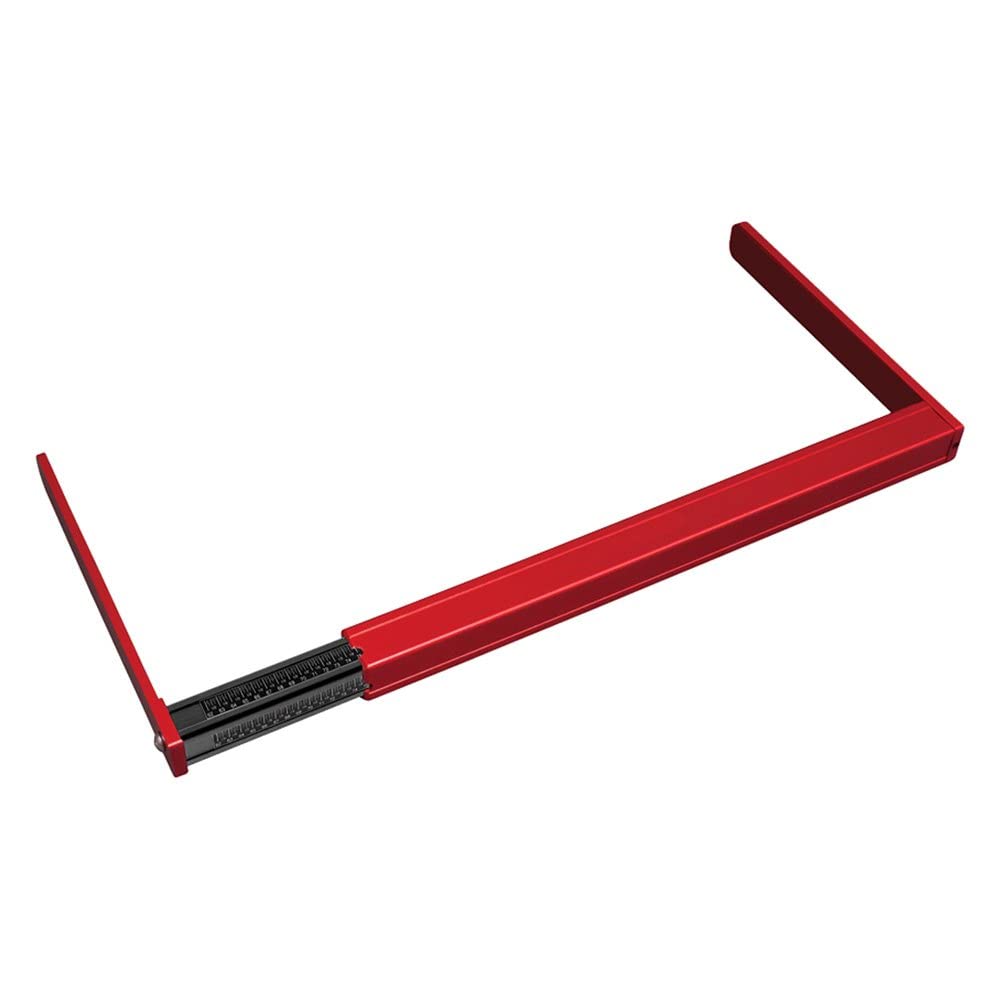 Representative Photo, actual item may vary


 Representative Photo, actual item may vary

What Is a Tire Stagger Gauge — and Why Does It Matter?
Tire stagger is one of the most fundamental handling adjustments on any circle track race car. Tire stagger is defined as the difference in circumference between the right-side tires and the left-side tires on the same end of the car. On an oval track, the right rear tire travels a longer distance than the left rear because the car is constantly turning left — so running a larger tire on the right side helps the car naturally arc through corners without fighting the driver.
Getting stagger right is a balancing act. Too much stagger and the car becomes loose, with the right rear losing traction and continuing to grow as heat and pressure build up during the race. Too little stagger and the car will push or understeer through the corners, costing both time and tire life. The correct amount depends on track radius, banking, and your car's overall chassis setup.
Because tire circumference changes with air pressure — and because tires from the same manufacturer can vary batch to batch — relying on sidewall markings alone isn't enough. A dedicated tire stagger gauge lets you measure each tire's actual circumference quickly and precisely, with the tires mounted on the car and inflated to race pressure. The difference between those two measurements is your stagger number.
How Stagger Gauges Work
Most stagger gauges are built from lightweight aluminum tubing with two arms that extend outward to contact the tire's tread surface at its widest point. A graduated scale on the tube body reads circumference directly in inches, typically ranging from around 62" to 115" to cover everything from karts to full-size late models. Some models add a roller on one end for faster, smoother contact, while more advanced digital versions store the first tire's measurement and automatically calculate the stagger difference when you measure the second. Readings should always be taken with tires at operating pressure, measuring at the center of the tread.
Top Brands for Tire Stagger Gauges
Longacre Racing Products is the benchmark name in circle track setup tools, and their stagger gauges reflect that reputation. Their billet aluminum designs feature thick 3/8" T6 billet arms for extra rigidity, tight-tolerance inner and outer tubes to eliminate measurement slop, and scales printed on both sides so the gauge is easy to read whether the tire is on or off the car.
JOES Racing Products offers stagger gauges built to 1/16" increments using a rectangle tube design with arms up to 3/4" thick — a solid choice for racers who want fine-resolution readings in a durable, no-nonsense package.
Allstar Performance provides an accessible aluminum stagger gauge covering the 65" to 115" range in 1/4" increments — a practical option for racers who need reliable measurements without added complexity.
Wehrs Machine takes a high-tech approach with their patented digital stagger stick: measure one tire, press a button to hold that reading, measure the second tire, and the display instantly shows both the circumference and the calculated stagger — all in a matter of seconds.
Milton Industries rounds out the category with straightforward, dependable tire measurement tools trusted by racers looking for accurate, shop-grade instruments at a competitive price point.
What to Look for When Choosing a Stagger Gauge
- Measurement range: Make sure the gauge covers your tire sizes. Most full-size circle track tires fall between 65" and 115" circumference.
- Increment precision: Gauges marked in 1/8" or 1/16" increments give you finer resolution for precise chassis tuning.
- Arm thickness and rigidity: Thicker billet arms reduce flex and keep measurements consistent across sessions.
- Roller end vs. flat end: A roller end speeds up measurements, especially when checking multiple tires back-to-back at the track.
- Digital vs. analog: Digital models calculate the stagger for you automatically, reducing the chance of arithmetic errors during a busy pit stop.