


Pintle Hook Trailer Hitch



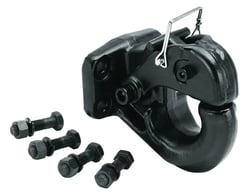



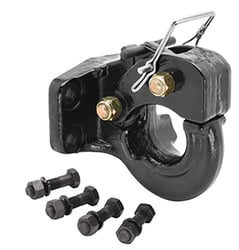

 Representative Photo, actual item may vary



 Representative Photo, actual item may vary
 Representative Photo, actual item may vary
What Is a Pintle Hook Trailer Hitch?
When standard ball hitches reach their limits, a pintle hook trailer hitch steps up to the challenge. A pintle hitch is a heavy-duty towing connection that uses a hook-and-loop design: the pintle hook mounts on the tow vehicle, while a lunette ring (also called a lunette eye) is bolted to the trailer tongue. The hook jaws lock around the ring and are secured with a locking arm and safety pin, creating a robust mechanical bond engineered for serious work.
How Does a Pintle Hook Work?
The coupling process is straightforward yet highly effective. The lunette ring on the trailer is dropped down onto the pintle hook mounted on the vehicle side. A spring-loaded locking arm on top of the hook pivots down to capture the ring, and a retainer pin or safety pin locks the arm in the closed position. To uncouple, simply remove the pin, open the locking arm, and release the ring. The entire system is designed to be fast to connect and nearly impossible to accidentally disengage under load.
One key characteristic that sets pintle hitches apart is the controlled articulation they allow between vehicle and trailer. Unlike a ball coupler, which fits snugly over the hitch ball, the pintle hook leaves intentional room around the lunette ring, allowing both vertical and horizontal movement. This range of motion reduces stress on the frame and trailer tongue when traversing uneven ground, making pintle hitches the go-to choice for off-road, construction, agricultural, and military towing.
Why Choose a Pintle Hook Over a Ball Hitch?
- Higher Towing Capacity: Pintle hitches are commonly rated from 20,000 to over 60,000 pounds gross trailer weight, far exceeding most standard ball mount setups.
- Superior Off-Road Maneuverability: The pivoting action enables the towed vehicle to articulate more freely, facilitating tighter turns and better navigation on rough or uneven terrain.
- Durability: Most pintle hooks are manufactured from forged or cast steel, built to withstand shock loads, vibration, and constant heavy use.
- Versatility: Combination pintle hooks that integrate a traditional hitch ball alongside the pintle hook let you tow both lunette-ring-equipped trailers and standard ball-coupler trailers without swapping hardware.
- Mounting Flexibility: Pintle hooks can be bolted directly to a reinforced bumper or mounted into a standard receiver tube via a shank plate, accommodating a wide range of truck and trailer configurations.
What to Consider When Shopping for a Pintle Hook Trailer Hitch
Before purchasing, verify your tow vehicle's receiver size (commonly 2" or 2-1/2") and match it to the shank of your pintle hook. Always confirm that both the pintle hook and the lunette ring carry a gross trailer weight (GTW) rating that exceeds the loaded weight of your trailer. Height compatibility also matters — look for adjustable-mount or drop/rise options if there is a significant height difference between your hitch receiver and the trailer tongue. Finally, consider a combination hitch if you regularly tow different trailer types, since the integrated ball offers added flexibility without requiring additional equipment.
Regular maintenance — including greasing the hook pivot, inspecting for wear, and verifying that locking pins remain secure — extends the life of your pintle hitch and keeps every tow safe.
Top Brands in Pintle Hook Trailer Hitches
Blue Ox brings decades of towing expertise to their pintle hook lineup. Their adjustable ball mount and pintle hook combinations are engineered to fit 2" and 2-1/2" receivers and feature built-in anti-rattle devices, corrosion-resistant finishes, and adjustable drop/rise functionality — making them a smart, versatile pick for drivers who tow a variety of trailer types.